
When Do You Need a Chartered Engineer Certificate in India?

A Chartered Engineer certificate is usually required when a business, importer, manufacturer or project owner needs engineering-backed technical certification for a specific documentation purpose. In India, this requirement commonly comes up in matters related to used machinery import, EPCG / DGFT documentation, installation of imported capital goods, project cost certification, technical verification and industrial documentation support.
The important point is simple: there is no single universal Chartered Engineer certificate for every requirement. The correct certificate depends on the purpose of documentation, the type of machinery or project involved, the supporting documents available and the format or requirement communicated by the concerned department, authority, bank, client or internal team.
For industrial businesses, this makes it important to first understand why the certificate is needed before preparing the document.
What Is a Chartered Engineer Certificate?
A Chartered Engineer certificate is an engineering-backed technical document issued by a qualified Chartered Engineer for a specific requirement. It may be used to support technical details related to machinery, equipment, installation, project cost, capital goods, process use or other industrial documentation.
In practical business situations, the certificate may help explain:
what the machinery or equipment is
how it is intended to be used
whether it is connected with a project or production process
whether imported capital goods have been installed
whether technical details are consistent with available documents
whether engineering review is needed for a specific documentation purpose
A Chartered Engineer certificate is not a replacement for legal, tax, customs or financial advice. It is a technical certification or supporting engineering document based on the requirement and available records.
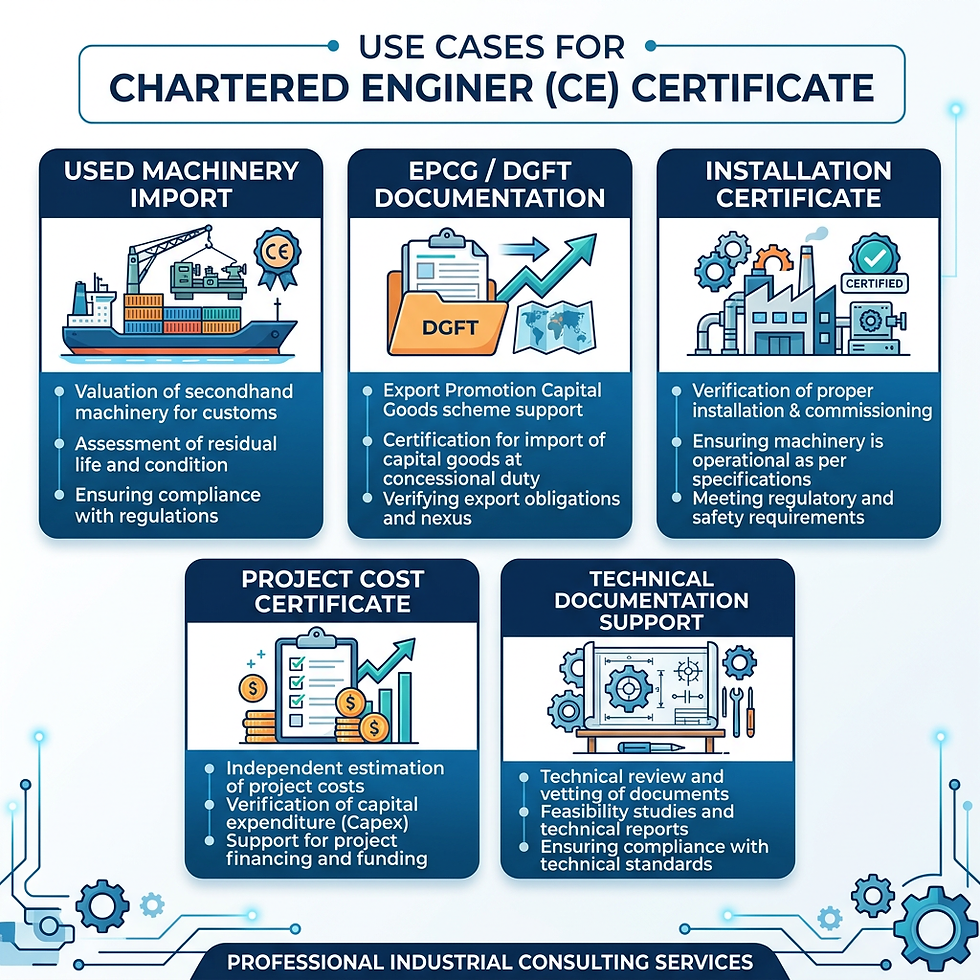
Common Situations Where a Chartered Engineer Certificate Is Needed
Businesses may need Chartered Engineer support in several practical situations. The most common cases are explained below.
1. Used or Second-Hand Machinery Import
One of the most common requirements is a Chartered Engineer certificate for used or second-hand machinery import.
This may be needed when an importer brings used machinery, refurbished equipment, second-hand production lines or industrial machinery into India. The certificate may support technical documentation related to the machinery details, identification, condition-related observations, specifications and import-linked records.
Typical information reviewed may include:
commercial invoice
packing list
machinery photographs
nameplate photograph
make, model and serial number
year of manufacture, where available
technical specifications
country of origin
intended use in India
project or installation context
A clear document set helps reduce confusion because used machinery often involves older records, unclear nameplates, partial documentation or multiple equipment items shipped together.
Related service : Used Machinery Import Certificate https://www.sarkengg.in/services/chartered-engineer/used-second-hand-machinery-import-certificate
2. EPCG / DGFT Documentation
Another important use case is EPCG / DGFT Chartered Engineer certification.
In EPCG-linked documentation, the technical purpose is often to establish the relationship between capital goods and the production, process or export activity of the business. This is commonly understood as technical nexus or requirement-linked justification.
A Chartered Engineer certificate in such cases may help explain:
what capital goods are proposed or imported
how they connect with the production process
why the machinery is technically relevant
how the equipment supports manufacturing, processing or export activity
whether the stated machinery is consistent with the project or plant requirement
This type of certification should be prepared carefully because EPCG / DGFT documentation is purpose-specific. The certificate should match the actual business activity, machinery details and supporting records.
Related service : EPCG / DGFT Chartered Engineer Certificate
3. Installation Certificate for Imported Capital Goods
After machinery or capital goods are imported, a business may need an installation certificate confirming that the equipment has been installed at the declared premises.
This requirement may arise where documentation needs to show that imported machinery has not only arrived but has also been installed for its intended industrial or project use.
Installation certification may involve review of:
imported machinery details
installation location
photographs of installed equipment
invoice and import documents
plant or project context
equipment identity and technical details
installation status based on available information
An installation certificate is different from a used machinery import certificate. The used machinery certificate is generally linked to the import/documentation stage, while an installation certificate is linked to whether the machinery has been installed at the site.
Related service: Installation Certificate https://www.sarkengg.in/services/chartered-engineer/installation-certificate
4. Project Cost Certificate
A project cost certificate by a Chartered Engineer may be required when an industrial or technical project needs engineering-backed documentation of project cost basis.
This may apply to projects involving:
plant setup
machinery installation
utility systems
process systems
treatment plants
industrial expansion
technical infrastructure
project implementation support
This certificate is not an accounting audit certificate. It is a technical certification based on engineering understanding, project scope and available supporting records.
Typical documents may include project details, machinery records, invoices, quotations, technical specifications, equipment lists, civil or utility details and project-related cost information.
Related service: Project Cost Certificate https://www.sarkengg.in/services/chartered-engineer/project-cost-certificate
5. Technical Documentation for Industrial Projects
Sometimes a business may not be sure which specific certificate is needed. The requirement may simply say that a Chartered Engineer certificate or technical certification is required.
In such cases, the first step is to understand:
who has asked for the certificate
what purpose the certificate will serve
which machinery, project or asset is involved
whether the matter relates to import, installation, EPCG/DGFT or project cost
what documents are available
whether any prescribed format has been provided
This review helps avoid preparing the wrong certificate. A certificate prepared for one purpose may not be suitable for another purpose.
Chartered Engineer Certificate Use-Case Matrix
Business situation | Certificate or support usually required | Typical purpose |
Importing used machinery | Used machinery import certificate | Supports technical documentation for used or second-hand machinery import |
EPCG / DGFT documentation | EPCG / DGFT Chartered Engineer certificate | Explains technical nexus between capital goods and business activity |
Imported capital goods installed | Installation certificate | Confirms installation of machinery at the declared premises |
Industrial project cost documentation | Project cost certificate | Supports engineering-backed project cost documentation |
Unsure about requirement | Requirement review | Helps identify the correct certification route |
Machinery or project needs technical explanation | Technical documentation support | Supports structured engineering clarification |
Why One Certificate Does Not Fit Every Requirement
A common mistake is assuming that one Chartered Engineer certificate format can be used everywhere.
That is usually not correct.
For example:
a used machinery import certificate is different from an EPCG nexus certificate
an EPCG / DGFT certificate is different from an installation certificate
an installation certificate is different from a project cost certificate
a project cost certificate is different from a machinery condition or import-linked certificate
Each certificate must match the actual requirement.
This is why businesses should avoid generic certificate requests like “we need a CE certificate” without explaining the purpose. The better approach is to share the background, required format, machinery details and relevant documents first.

Documents Usually Needed Before Requesting a Chartered Engineer Certificate
The exact documents depend on the certificate type, but businesses should generally keep the following ready:
company details
purpose of certificate
invoice or commercial documents
machinery or capital goods details
technical specifications
make, model and serial number, where applicable
photographs of machinery or installation
nameplate photograph, where available
import documents, if relevant
project details, if relevant
installation location, if applicable
EPCG / DGFT reference, if applicable
any specific format or instruction received
Having these documents ready helps the Chartered Engineer understand the requirement and reduces unnecessary back-and-forth.
Common Mistakes Businesses Should Avoid
Chartered Engineer certification can become delayed or confusing when the requirement is unclear. Common mistakes include:
asking for a generic certificate without defining the purpose
sharing incomplete machinery details
not providing photographs or nameplate details
confusing import certification with installation certification
assuming EPCG documentation is the same as project cost certification
not sharing the format required by the concerned department or authority
submitting inconsistent invoice, machinery and technical records
not explaining intended use of the machinery or capital goods
waiting until the last moment before arranging documents
A better approach is to first identify the certificate type and then organize the documents accordingly.
How to Decide Which Chartered Engineer Certificate You Need
Use this simple step-by-step approach:
Step 1: Identify who is asking for the certificate
The requirement may come from a department, bank, customs-related process, DGFT/EPCG documentation, client, internal management or project authority.
Step 2: Understand the purpose
Ask whether the certificate is required for import, EPCG/DGFT, installation, project cost, technical clarification or another documentation purpose.
Step 3: Identify the asset or project involved
The certificate may relate to a machine, plant, production line, utility system, imported capital goods or project cost.
Step 4: Check whether any format is prescribed
If a specific format has been provided, it should be reviewed before drafting the certificate.
Step 5: Collect supporting documents
The certificate should be based on available records, machinery details, technical documents and project information.
Step 6: Match the certificate to the requirement
The final certificate should not be generic. It should reflect the actual purpose and technical basis.
How SARK Engineers & Consultants Supports Chartered Engineer Requirements
SARK Engineers & Consultants provides Chartered Engineer services for industries, importers, exporters, manufacturers and project teams requiring engineering-backed technical certification and documentation support.
Our Chartered Engineer services include:
used machinery import certificate support
EPCG / DGFT Chartered Engineer certificate support
installation certificate support
project cost certificate support
requirement-specific technical documentation support
The focus is to understand the purpose of the certificate, review available technical documents and support the correct certification route based on the actual requirement.
Explore Chartered Engineer Services: https://www.sarkengg.in/services/chartered-engineer
FAQs
1. When is a Chartered Engineer certificate required in India?
A Chartered Engineer certificate may be required when a business needs engineering-backed technical certification for used machinery import, EPCG / DGFT documentation, installation certification, project cost certification or other industrial documentation purposes.
2. Is one Chartered Engineer certificate suitable for all requirements?
No. Different requirements need different types of certificates. A used machinery import certificate, EPCG nexus certificate, installation certificate and project cost certificate serve different purposes.
3. What documents are needed for a Chartered Engineer certificate?
Documents may include invoice, machinery details, technical specifications, photographs, nameplate details, project information, import documents, installation details, intended use and any prescribed format or requirement.
4. Who needs a Chartered Engineer certificate?
Importers, exporters, manufacturers, industrial project owners, plant teams and businesses dealing with machinery, capital goods, project documentation or EPCG / DGFT-linked requirements may need Chartered Engineer certification.
5. Can a Chartered Engineer certificate support used machinery import?
Yes. Used or second-hand machinery imports often require technical documentation support, including machinery identity, specifications, photographs, nameplate details, condition-related observations and intended use.
6. Is EPCG certification different from installation certification?
Yes. EPCG / DGFT certification usually relates to capital goods and their technical nexus with business activity, while installation certification relates to whether imported machinery has been installed at the declared premises.
7. Is project cost certification the same as accounting audit?
No. A project cost certificate by a Chartered Engineer is an engineering-backed technical document. It is not a statutory accounting audit certificate.
Conclusion
A Chartered Engineer certificate is needed when a business requirement calls for engineering-backed technical certification or documentation. The requirement may relate to used machinery import, EPCG / DGFT documentation, installation of imported capital goods, project cost certification or other technical records.
The key is to first identify the purpose. Once the purpose is clear, the correct certificate type, document list and technical basis can be decided.
For industries, importers and project teams, this avoids confusion and helps prepare more accurate technical documentation.
Need help identifying the right Chartered Engineer certificate? SARK Engineers & Consultants can review your requirement, machinery details and available documents to help identify the correct certification route.

Comments